Shipping holiday notice: Our facilities will be closed for shipping the weeks of May 25 and July 6.

Get 10% Off plus 1lb of Free Ground Beef
on every order when you use Subscribe and Save at Checkout!

Cozy Crocks in Cozy socks

written by

Jordan Ems

posted on

October 13, 2025

Cozy Crocks in Cozy Socks

There's something about October that makes me want to pull on my thickest socks, light a fire, and let something delicious simmer away in the crock pot all day long. The air gets crisp, the leaves start their show, and suddenly all I'm craving is the kind of meal that fills the house with warmth before it ever hits the table.


My brother, Christian, has been busy prepping the farm for winter—fixing fence, checking water sources, and making sure the herd has everything they need as the temperatures drop. Meanwhile, I've been thinking about comfort food. The kind that requires almost no effort but delivers maximum coziness.

That's why we're running a special on our Crock Pot Bundle this month—30% off while supplies last.

What's in the Bundle?

This box is basically Fall, in a freezer package:

  • One beautiful Brisket (perfect for when you want to impress yourself)
  • Two Chuck Roasts (the MVPs of pot roast season)
  • Two Arm Roasts (amazing for those "set it at 8am, eat at 6pm" kind of days)
  • Two pounds of Stew Meat (because soup season is officially here)
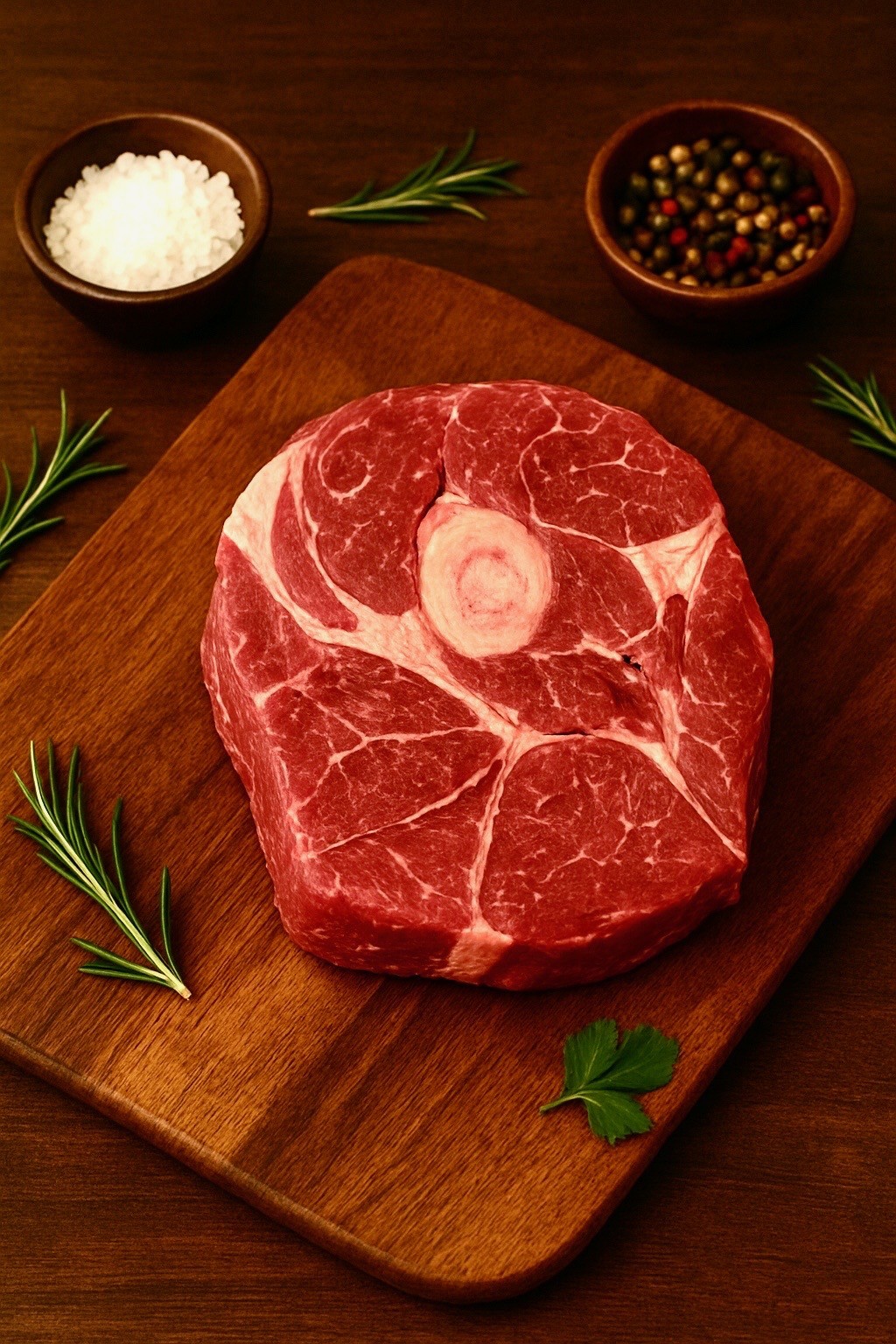
Our beautiful arm roast

Every cut from our cattle is premium. Pastured-raised and pasture-grazed here on our Missouri farm, finished with care, and processed locally. Christian takes pride in raising beef that tastes like beef should. These slow-cooking cuts really let that flavor shine.

The Simplest Chuck Roast You'll Ever Make

If you're new to slow cooking (or just want a foolproof recipe), here's my go-to chuck roast method:

Equipment:

Crock pot or Dutch oven  

What you need:

  • 1 Parsons Creek chuck roast (3-4 lbs)
  • 1 whole onion
  • 1 garlic clove
  • 1 bag carrots
  • 4 peeled quartered potatoes 
  • Salt and pepper with your soul 

What you do:

  1. Put the chuck roast in your crock pot
  2. Add Onion, garlic, carrots, potatoes, salt & pepper  
  3. Add 1-2 cups of water (more if you're planning to make gravy) 
  4. Crockpot - Cook on low for 8 hours (or high for 4-5 hours) 
  5. Dutch oven - Cover and cook at 250 for 8 hours (or 4-5 hours at 350) 
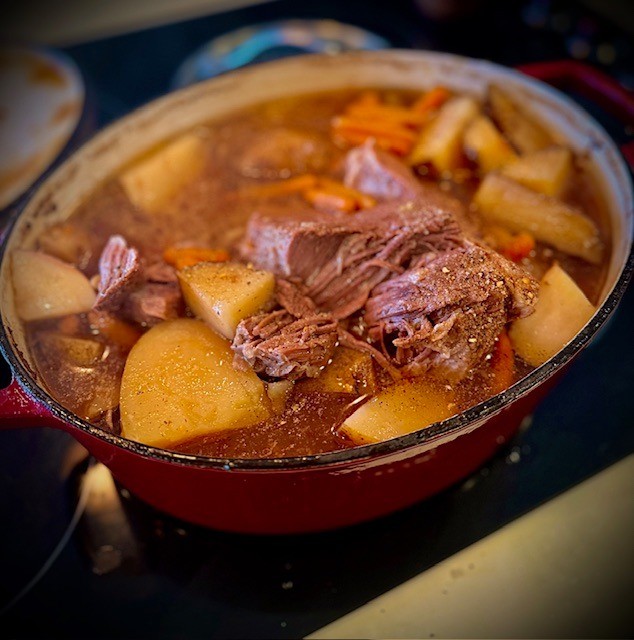

That's it. No searing, no fancy technique. Just come home to beef so tender it falls apart with a fork, swimming in the most flavorful aju you've ever made without really trying.

Serve it over mashed potatoes, egg noodles, or with a crusty piece of bread to soak up all that goodness.

The Best Part of Slow Cooking Season

What I love most about crock pot cooking isn't just the ease—it's the way it makes the whole house smell like home. You start it in the morning, go about your day, and by evening, you've got a meal that tastes like you spent hours on it. It's the kind of cooking that feels laborious, even though it's incredibly simple (in the best way).

With beef from our farm, you're getting meat that actually tastes like something. Pasture-raised, grain-finished, no shortcuts. Just the way our family has been doing it for five generations.

Grab Your Bundle

Our Crock Pot Bundle is 30% off all October, which means now's the time to stock your freezer for the cozy months ahead. Whether you're a crockpot veteran or just getting started, these cuts will make you look like a kitchen genius with minimal effort.

Head over to our store to order yours while we still have them in stock.

And hey—if you try that chuck roast recipe, let me know how it turns out. I'm always curious what everyone's making with our beef.

Here's to sweater weather, slow cookers, and meals that taste like a hug.

— The Parsons Creek Steak Family

More from the blog

From Our Pasture to Your Pan: The Case for Making Tallow at Home

There's a quiet revolution happening in kitchens across the country, and it looks a lot like something your great-grandmother would recognize. People are setting aside the seed oils and reaching instead for something older, simpler, and more nourishing — beef tallow. Here at Parsons Creek Steak, we've been raising Black Angus cattle on the grasslands of northern Missouri for five generations. We know every pasture and the cattle that graze them. So when people started asking us about rendering tallow from our beef fat, we couldn't have been more thrilled. Because tallow isn't just a cooking fat — it's a way of honoring the whole animal, reducing waste, and connecting back to the kind of real-food traditions that built this country. Let me tell you why tallow deserves a permanent spot in your kitchen. What Is Tallow, Exactly? Tallow is simply rendered beef fat. "Rendering" is the process of slowly melting raw fat over low heat until the pure fat separates from any remaining tissue. What you're left with is a beautiful, creamy white cooking fat that solidifies at room temperature — shelf-stable, deeply flavorful, and incredibly versatile. That's it. One ingredient. No additives, no preservatives, no industrial processing. Just pure beef fat, rendered down to its essence. Why Tallow Is Having a Moment — and Why It Deserves One 1. This Is How People Cooked Before Processed Oils Took Over Before canola oil, before vegetable shortening, before seed oils became a supermarket staple, beef tallow was the fat American families cooked with every single day. McDonald's famously fried their original French fries in beef tallow — and food writers will tell you nothing has ever tasted quite the same since they switched. There's a reason this generation is rediscovering tallow. As people take a harder look at ultra-processed foods and unfamiliar ingredients, many are choosing to return to the foods their ancestors thrived on. Tallow fits squarely in that tradition — and it fits right alongside our family's mission of farming the way it's always been done. 2. The Source of the Fat Matters Enormously Not all tallow is created equal. Just like you wouldn't buy a mystery burger from an unknown source, you want to know where your cooking fat comes from. Our cattle are pasture-raised on the open grasslands of northern Missouri. They spend their days outside, in the sunshine, free from routine antibiotics and added growth hormones. The quality of an animal's life and diet directly affects the quality of its fat. Tallow rendered from well-raised, pasture-raised cattle is richer in fat-soluble vitamins like A, D, E, and K2. It contains higher levels of conjugated linoleic acid (CLA) — a beneficial fatty acid associated with a range of positive health effects. And it's loaded with oleic acid, the same monounsaturated fat celebrated in olive oil. When you render tallow from Parsons Creek Steak beef, you're not getting a commodity byproduct. You're getting the result of five generations of careful, intentional farming. 3. It's One of the Best Cooking Fats You Can Use From a pure cooking standpoint, tallow is exceptional. It has a smoke point of around 420°F — well above the temperatures needed for searing, frying, and roasting. Unlike many vegetable and seed oils, tallow remains stable at high heat and doesn't break down into harmful compounds. Want a perfect sear on a ribeye? Start with tallow. Making roasted potatoes with a crackling crust? Tallow. Frying eggs with rich, golden edges? Tallow. Wherever you'd normally reach for butter, olive oil, or vegetable oil, tallow is a worthy — and often superior — replacement. And the flavor. There's a depth and richness that tallow brings to food that's hard to put into words. It's beefy and savory without being overpowering. Once you've made potatoes roasted in tallow, you'll struggle to go back. 4. It's About Using the Whole Animal On a working family farm, waste is something we simply don't accept. When you raise an animal with care and intention, the way we do, you want every part of it to be used well. Rendering tallow is one of the most meaningful ways to do that. The fat that surrounds the kidneys — called leaf lard or suet — has historically been the most prized for rendering because it produces the purest, most neutral tallow. Rather than letting that go to waste, rendering it at home is a way of completing the circle. It's a practice that our grandparents and great-grandparents understood instinctively: respect the animal by using everything it provides. It's what we call nose-to-tail eating, and it's not just a trend — it's a philosophy of respect. 5. People Are Using It for a Lot More Than Cooking Here's something that might surprise you: tallow has become a darling of the natural skincare world. The fatty acid profile of beef tallow is remarkably similar to the oils naturally produced by human skin, which is why many people find it deeply moisturizing and gentle. A growing number of people are using it as a facial moisturizer, a lip balm base, a healing salve for dry or cracked skin, and even a hair treatment. If you're someone who reads ingredient labels on your skincare products and finds yourself overwhelmed by the list, tallow is about as simple as it gets: one ingredient, animal-derived, deeply traditional. How to Make Tallow at Home Using Parsons Creek Beef Fat Making tallow is a slow, simple process that rewards patience. Here's how to do it: What you'll need: Raw beef fat or suet from Parsons Creek Steak  A heavy-bottomed pot or slow cooker A fine-mesh strainer or cheesecloth Clean glass jars for storage Instructions: Step 1: Prepare the fat. If your fat has been frozen, thaw it completely in the refrigerator. Trim away any remaining meat or connective tissue, and cut or grind the fat into small, uniform pieces. Smaller pieces render more quickly and evenly. Step 2: Render low and slow. Place the fat in a heavy-bottomed pot or slow cooker on the lowest heat setting. You're not frying it — you're slowly coaxing the fat to melt away from any solids. Stir occasionally. This process takes 2 to 4 hours on the stovetop or longer in a slow cooker. You'll know it's ready when the fat is fully melted, the liquid is clear golden-yellow, and any remaining solids (called "cracklings") have sunk to the bottom and turned lightly golden. Step 3: Strain carefully. Pour the rendered fat through a fine-mesh strainer or cheesecloth-lined colander into clean glass jars. This removes any solids that could cause the tallow to spoil more quickly. Step 4: Cool and store. Let the jars cool at room temperature. As tallow cools, it will turn from golden to a beautiful creamy white. Store at room temperature for a few weeks, in the refrigerator for several months, or in the freezer for up to a year. Pro tip: Don't discard the cracklings! Season them with a little salt and enjoy them as a snack — they're the original pork rind, except made from beef. A Fat Worth Knowing There's something genuinely meaningful about making tallow at home. It connects you to a long tradition of resourceful, whole-food cooking. It puts a nourishing, stable fat on your counter that you made with your own hands from an animal you know was raised well. That connection between the farm and your table is exactly why we do what we do. Christian and Madison returned to this land to continue a fifth-generation legacy — not just to raise cattle, but to feed families with food they can trust. Tallow is one more way we can do that. If you're ready to try rendering your own tallow, we hope to be your first stop to make that dream a reality. And as always, if you have questions about our farm, our practices, or our products, we love hearing from you. From our pasture to your kitchen — thank you for being part of the Parsons Creek family. Shop our pasture-raised Black Angus beef at parsonscreeksteak.com and follow us on Facebook and Instagram for farm updates, recipes, and specials.

The Food Pyramid Just Got Flipped—And It All Starts in the Dirt

The Food Pyramid Just Got Flipped—And It All Starts in the Dirt On January 7th, Secretary Brooke Rollins and Secretary Robert F. Kennedy Jr. unveiled the new Dietary Guidelines for Americans, 2025-2030. With them came something we haven't seen in over a decade: an actual food pyramid. But this one's different. It's inverted. At the very top—the foundation of healthy eating—sits protein, dairy, healthy fats, vegetables, and fruits. Real, whole, nutrient-dense food. "Eat real food," Secretary Kennedy said. "These guidelines return us to the basics." Whether you agree with the intricacies of the guidelines or not, I think we can all agree that eating real food can’t hurt.  This isn't just about what's on our plates. It's about where that food comes from. And if we're going to eat real food—truly nutrient-dense food—we need to think about what's underneath it all. We need to think about the soil. From the Pyramid to the Ground Just one month before the food pyramid announcement, the USDA launched a $700 million Regenerative Pilot Program aimed to help American farmers adopt practices that improve soil health, enhance water quality, and boost long-term productivity, all while strengthening America’s food and fiber supply.  You can't have nutrient-dense beef without healthy pasture. You can't have a healthy pasture without living soil. You can't have living soil without regenerative practices that build instead of deplete. The new food pyramid says: prioritize protein from whole food sources. The Regenerative Pilot Program says: We're going to help farmers raise that food the right way. Healthy soil → real food → healthier people. It's the first time in my lifetime that I've seen the federal government connect these pieces. And for farmers like us who've been quietly working toward this for generations? It feels like hope. What We've Been Doing All Along The Regenerative Pilot Program focuses on soil health, water management, and natural vitality. If you've been reading our blog, you already know what that looks like. Cover Crops - We plant sorghum, triticale, cow peas, and winter mixes to prevent erosion and build nitrogen naturally. Healthy soil is never bare. No-Till Farming- We use a no-till drill to plant new crops right into the residue of the last one, protecting soil structure and those hardworking microorganisms underground. Rotational Grazing - Our Black Angus cattle move through pastures regularly. They graze and fertilize. We're working toward "mob grazing"—mimicking the way buffalo moved across the Great Plains for thousands of years. These practices build soil instead of mining it. They create beef that's more nutrient-dense because it comes from richer ground. And now, the USDA is putting $700 million behind helping more farmers do exactly this. Why This Gives Me Hope For years, we've watched good farmers want to do the right thing but get buried in red tape or worn down by a system that didn't value what they were trying to build. The Regenerative Pilot Program changes that. One application instead of ten. Whole-farm planning instead of fragmented bureaucracy. Real support for practices that actually work. This isn't just validation—it's transformation. Young producers won't have to fight as hard as Christian did when he moved back to the farm. New farmers can start with regenerative practices. Families can transition to soil-building methods with actual financial support. And with more regenerative farming, we all get access to better food. The beef in grocery stores and on dinner tables becomes more nutrient-dense, raised on healthier soil. The cycle strengthens. The Connection We've Been Missing The new Dietary Guidelines say: "Better health begins on your plate—not in your medicine cabinet." I'd take it one step further. Better health begins in the soil. When we talk about chronic disease in America, we can't ignore where our food comes from. The nutrients in beef trace back to the ground it came from. The flavor, the tenderness, the marbling—it all connects to soil health. The new food pyramid recognizes that real food matters. The Regenerative Pilot Program recognizes that real soil matters. And out here at Parsons Creek, we've always known both are true. What Comes Next I keep thinking about my daughter running around the farm in boots three sizes too big. She's inheriting not just land, but soil that's been tended, loved, and cared for. That's the promise of regenerative agriculture.  The new Dietary Guidelines told Americans to eat real food. The Regenerative Pilot Program is making sure farmers can grow it. And families like ours—who've been doing this work quietly for decades—now have support to keep going and expand. Papa always says, "You work for the land, and if you do it right, the land provides." The food pyramid starts at the top with protein and healthy fats. But we know the truth—it really starts in the dirt. In the soil we build, the practices we follow, the stewardship we choose. From our farm to your table, we're hopeful. Hopeful for the soil we're healing. Hopeful for the farmers getting support. Hopeful for the families choosing real food. Hopeful for the future we're building together, one regenerative practice at a time. Want to learn more about the USDA Regenerative Pilot Program? Visit nrcs.usda.gov/programs-initiatives/regenerative-pilot-program Ready to taste what healthy soil can do? Shop Parsons Creek Steak and support regenerative agriculture with every meal.

with customization by Taste Profit Marketing